
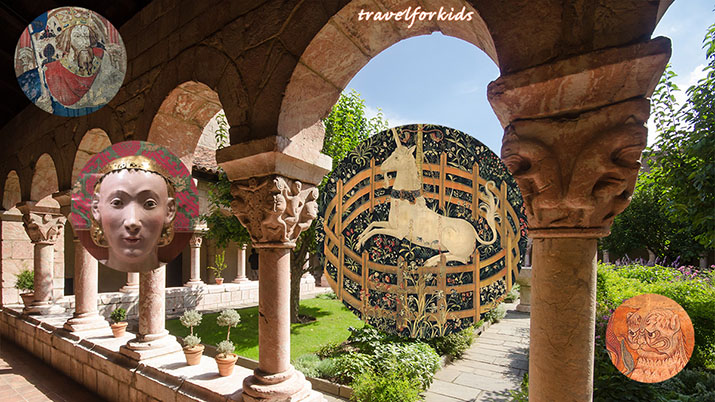
Perfect for a winter day, or any day, explore the Met Cloisters Museum with colorful medieval tapestries of unicorns, and much more.
The Cloisters displays statues, paintings, stained glass, tapestries from the Middle Ages, set in medieval architecture from Europe.
This blog post will make it easy follow Unicorn Tapestries narrative Gallery 17, more mythical creatures, King Arthur, knights, lords and ladies in the castle, lions, dragons and more. Plus tips for visiting!
Unicorn Tapestries
The Unicorn Tapestries, also called Hunt of the Unicorn, are the most famous artworks in the museum.
Unicorn Tapestries are on display in Gallery 17.
Scene 1 – Hunters go into the forest
Upper right, note hunter in forest thicket, gesturing that unicorn has been found.
Scene 2 – Unicorn dips horn into the stream
The unicorn is completely surrounded by the hunters, but in front animals gather around the unicorn.
Scene 3 – Unicorn crosses the stream
Hunters begin to attack the unicorn with their spears.
Scene 4 – Unicorn defends against the hunters
The unicorn kicks one of the hunters with his hind legs, injures a hunting dog with unicorn’s magical horn.
Tip: The wounded dog is at eye level for younger kids. Time for a story – “Oh, the dog will get taken to the castle to get stitched up.”
Scene 5 – Maiden and the unicorn
Two smaller tapestry fragments, the unicorn is in a garden with a young woman and hunting dogs. On right, don’t miss arm and a hand touching the unicorn’s neck.
Scene 6 – Unicorn is brought to the castle
In the upper left, two hunters wound the unicorn with their spears. In the center, unicorn is draped over a horse, and brought by the hunters to the lord and lady of the castle.
Scene 7 – Unicorn rests in the garden
Unicorn is clearly alive and well, but surrounded by a fence in a gorgeous garden filled with flowers and trees.
Tip: View each scene in order to follow the narrative.
Unicorn Tapestries, woven 1495-1505, have familiar imagery from the Middle Ages – hunters, a magical unicorn, maiden, lords and ladies of the castle.
The unicorn is magical, but hunters go after the unicorn with sharp spears and hunting dogs. It appears the unicorn is killed and brought to the castle for the lord and lady. In the last scene, unicorn is alive and well.
With younger kids, the hunt is understandably confusing.
But visiting museums with kids has an advantage – kids come up with stories about the art they see.
For a five year old, this her story:
Hunters capture the unicorn, and bring the unicorn to the castle.
But the princess says they can’t hurt the unicorn.
Unicorn is saved, everything ends happily.
Who’s the princess?
In castle scene, perhaps it’s the young woman wearing a bright red dress at right side of the tapestry. That’s our guess.
But what about Scene 5, young woman in dark red gown? Or mysterious hand touching the unicorn – could it belong to a princess?
For a five year old there’s always a princess out there to help out.
Faces from the past
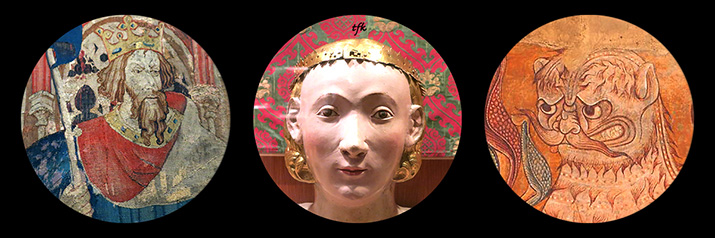
Here’s more artworks to see at the Cloisters – King Arthur, Queen Juliana, and lion with a mustache.
Gallery 18 – Heroes Tapestries 1400
Adjacent gallery to Unicorn Tapestries, on display are the Heroes Tapestries. These tapestries are among oldest surviving tapestries in the world. Wool tends to fall apart over the centuries, plus pesky moths, and medieval castles burned to the ground.
King Arthur is most recognizable. Poised on his throne, decked out in royal red and blue, his robe and banner are decorated with three gold crowns, representing England, Scotland and Brittany (France).
Gallery 14 – Saint Juliana Reliquary ca. 1376
This is a box with a sacred relic inside, made in Italy, from a convent in Perugia. Saint Juliana has lots of beautiful blond hair, topped with a gilded circlet. Her skin is perfect, lips tinted pink. The saint’s face looks like a real 14th century woman, an inspiration for artist who made the reliquary.
Gallery 01 – Lion painting, after 1200
When you step into Romanesque hall, on the wall is a large lion, staring down from above.
The lion was originally painted on the walls of a monastery in northern Spain, along with other mythical animals, a dragon and griffon.
Kids might wonder why the lion’s face looks like a person with a mustache. Any ideas?
In the Middle Ages, lions were portrayed everywhere – paintings, sculptures, in castles, on tombs, church door handles, thrones, coats of arms.
You’ll see lots of lions while exploring the Cloisters.
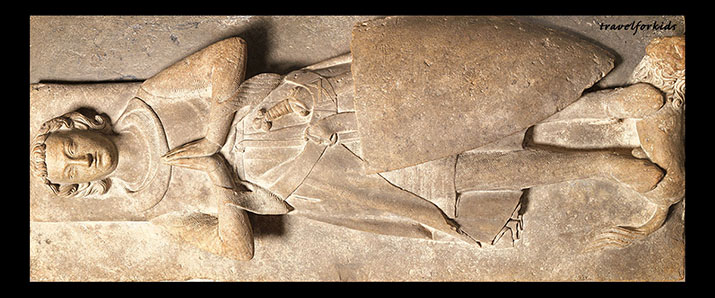
Gallery 09 – Knight d’Aluye Family 1248
This sarcophagus, from an abbey in France, is the tomb a 13th century knight whose family fought in the Holy Land. The knight has his hands in prayer, at his foot is a lion.
On the tomb sculpture, look at the incredible detail of the chain mail!
His sleeves are loose, arms are bare, but in battle, chain mail would have folded over his hands to protect them. Perhaps the gift shop has chain mail mittens.
Plan your visit
– Crowded Gallery 17
On weekends and holidays, Gallery 17 with the Unicorn Tapestries can be very crowded.
The tapestries are quite large, about 12 ft high, 8 ft wide. Lower third of a tapestry is eye level for younger kids. With crowds, tall adults make it hard to see upper parts of the tapestries.
Fortunately, lower parts of the tapestries are full of interesting stuff.
For example, in Scene 02 the unicorn dips his magic horn in the stream. Check out details of beautifully portrayed unicorn, including that swirly tail.
Next to the stream are two lions, hyena, a duck floats in the water, on the right is an orange tree. Large stag with huge horns stands next to the fountain, water flows out of a lion’s head into the stream, on the fountain are perched birds, a little rabbit nestles in the forest.
– Museum is closed on Wednesday, children under 12 are free.
– Cloisters outdoor cafe is open in summer. In the neighborhood are casual restaurants, cafes, sandwich shops for snacks and lunch.
– To get to the Cloisters, take the M4 bus uptown, last stop is Margaret Corbin Dr. – Cloisters.
– Anne Loftus playground – Next to the bus stop is large playground with climbing structures, slides, toddler swings, benches (in good weather bring a picnic).
The Met on Fifth Ave
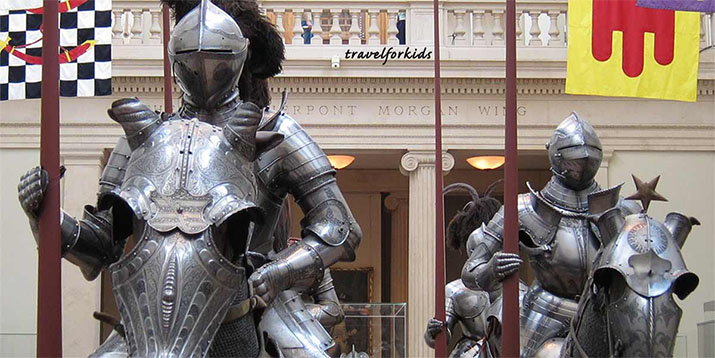
The Cloisters museum is a branch of the Metropolitan Museum of Art on Fifth Ave.
The Met has lots more art of the Middle Ages.
Check out stellar Arms and Armor Gallery. Gallery 371 and adjoining galleries are chock full of armor from Europe and other countries.
Read more: The Met Museum
More Unicorn Tapestries
On next trip to Europe, check out two other sets of tapestries – one in Paris, the other in Stirling Castle Scotland.
The Lady and the Unicorn – Musee du Moyen Age Paris
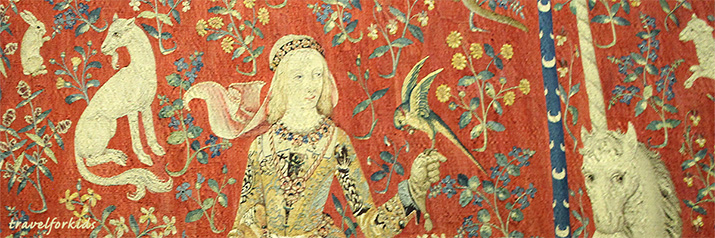
Six tapestries, designed in Paris, woven around 1500, the theme of the tapestries is the five senses – touch, taste, smell, hearing, sight, and courtly love.
Each tapestry has a striking red background filled with amazing details of flowers and trees, and a ladies in gorgeous gowns. One tapestry alone has eleven rabbits, two dogs, one fox, one lion cub, and the unicorn.
Read more: National Museum of the Middle Ages (Musee du Moyen Age)
Unicorn Tapestries – Stirling Castle Scotland
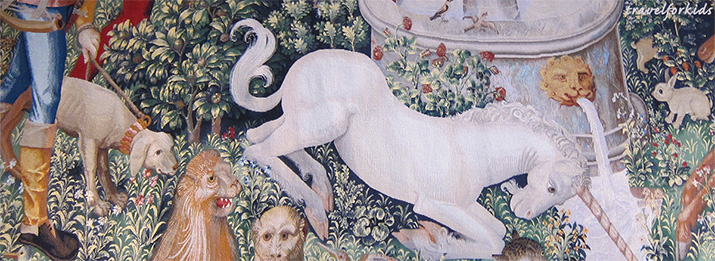
In the 16th century, unicorn tapestries decorated the walls in Stirling Castle, outside of Edinburgh. The castle was home of King James V and his queen Mary of Guise, parents of Mary Queen of Scots. What happened to the original unicorn tapestries is unknown.
The unicorn tapestries in Stirling Castle are not hundreds of years old, but the castle setting is impressive. To recreate the lost tapestries, new tapestries were hand-woven, based on the Unicorn tapestries from the Cloisters.
Tip: The unicorn is the coat of arms of Scotland, which you’ll see throughout the castle.
Read more: Stirling Castle Scotland
Thanks to our friend who took her five year old granddaughter to the Cloisters on a crowded weekend, started us thinking about great art and younger kids in a museum.

Travel for Kids
Created by people, not AI