
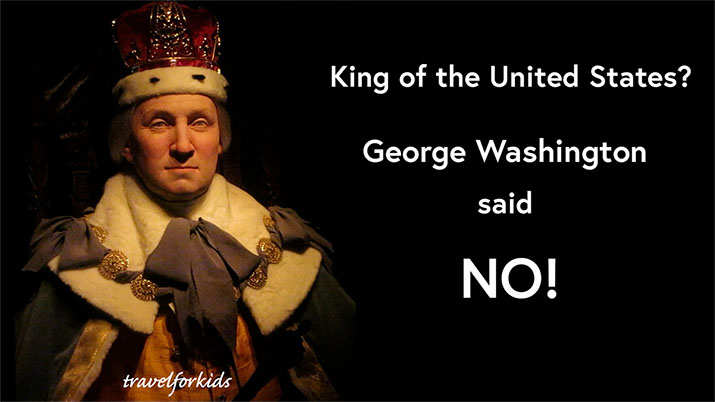
On our visit to Mt. Vernon, in the Education Center was an eye catching hologram about a significant event in George Washington’s life.
The hologram started with George Washington dressed in royal robes and a crown, then fades into George Washington standing tall in ordinary 18th century clothing, accompanied by the words “Instead he gave up power and returned to Mount Vernon.”
After colonists won War of Independence in 1783, Washington voluntarily resigned as Commander in Chief.
The year before, in May 1782 George Washington received a letter from an army officer. One problem was the issue soldiers hadn’t been paid.
In this letter, the officer was also critical of representative forms of government, and suggested the United States needed a king. King George, like King George of England?
In response to the letter, Washington decisively rejected this idea.
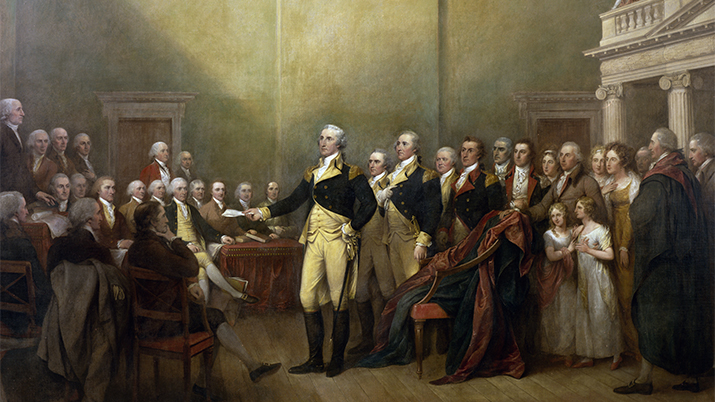
This painting in the Rotunda of the US Capitol shows Washington in 1783, stepping down as Commander in Chief, a role he held for eight years, since 1775.
Washington refused monarchy and power from the military in favor of democracy and elected government.
Historian Thomas Fleming sums up importance of Washington’s voluntary resignation.
“This was – is – the most important moment in American history. The man who could have dispersed a feckless Congress and obtained for himself and his officers riches worthy of their courage was renouncing absolute power to become a private citizen.”
Washington retired to Mt. Vernon, but in 1787 he returned to public life to lead the Constitutional Convention.
The Constitution mapped out three branches of government, with an elected president, Congress to pass laws, and a Supreme Court to uphold the laws.
In 1789, George Washington was elected the first president of the United States.
Find out more about George Washington and formation of the United States:
National Constitution Center Philadelphia: We the People
Museum of the American Revolution
Mt. Vernon: Washington at Home
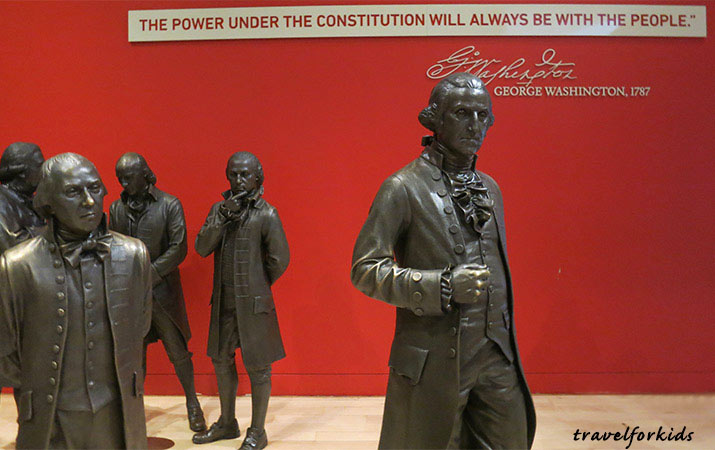
“The power under the Constitution will always be with the people.”
George Washington 1787
Travel for Kids
Created by people, not AI