
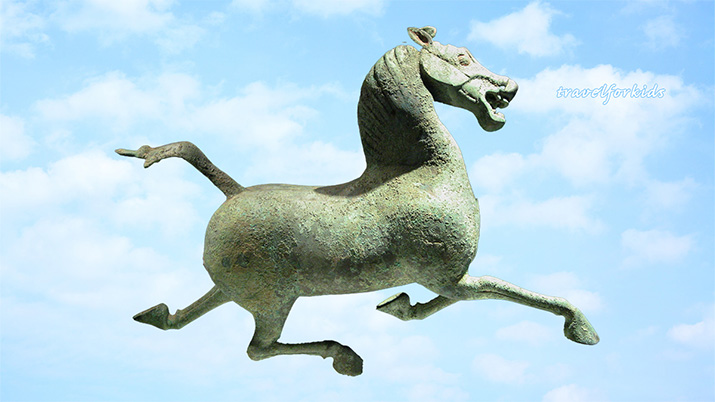
2026 is Year of the Horse, and horses have a special significance in Chinese history, culture and mythology.
In ancient China more than 2,000 years ago, horses with speed and endurance were imported from northwest lands and highly valued for transportation and war.
From the First Emperor of China through the Tang Dynasty, in tombs are horse figurines, reliefs and paintings.
In Chinese mythology, horses are the link between heaven and earth, and have divine, supernatural characteristics.
There are legendary horses, such as eight flying horses of King Mu, each with different colors and powers, and symbols of fortune, prosperity, protection, nobility.
Longma are dragon-horses with a combination of power over water, divine strength, ability to change appearance, endurance to “walk through ten thousand waters and a thousand hills.”
White Dragon Horse in Journey to the West looks like a typical white horse, but is a divine horse, only restored to dragon form when he’s completed his journey.
Terra Cotta Army – First Emperor of China
Near Xi’an, the tomb of the First Emperor of China is an archaeological wonder.
Built over 2,200 years ago, the tomb contains thousands of earthenware warriors and horses, lined up as if ready for battle.
In war, cavalrymen rode horses with decorated saddles and metal bridles, wooden chariots were pulled by four horses, driven by a charioteers.
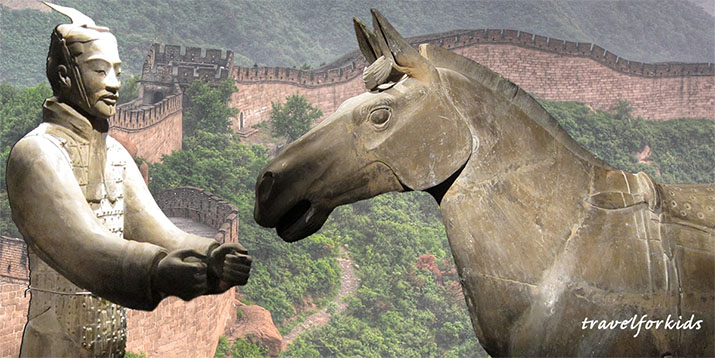
In the photo above, terra cotta figure is a charioteer, horse is saddled for a rider.
Han Dynasty Art – Heavenly horses
A special breed of Chinese horses is called “heavenly horses.”
Emperor Wu of the Western Han dynasty took a huge army into the Fergana Valley to obtain a special horse valued for speed and endurance. When the Emperor successfully returned to China with a herd of horses, it was a sign of divine favor, so he named the horses “heavenly horses.”
In the Han Dynasty, heavenly horses were spectacularly crafted by ancient Chinese potters – clay horse figurines for tombs and decorations on mausoleums.
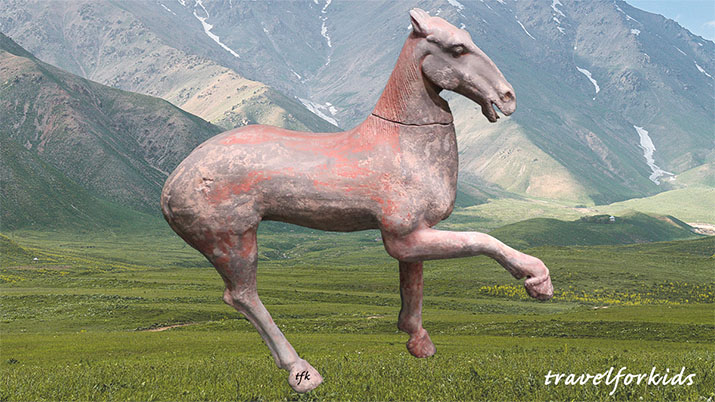
Western Han dynasty 206 – 09

Incised brick on Western Han dynasty tomb
Tang Dynasty Art
In the Tang dynasty, art flourished, tombs were decorated with mural paintings, and large numbers of ceramic objects, people and animals figurines are found in Chinese tombs.
Horses are the most popular animals, and are distinctively decorated with bright multi colored glazes – green, yellow-brown, white and blue.

Tang dynasty (618 – 907)
Horses in the Tang dynasty were essential for warfare, and also hunting and sports. Both men and women participated in equestrian sports, games like polo.
Emperor Taizong, one of the most famous Tang emperors, ordered six reliefs carved with portraits of his favorite horses used in military campaigns.
Emperor Taizong wrote, “Those war chargers which carried me rushing on the enemy and breaking the line, and which rescued me from perils, their true images should be portrayed on stone and be placed left and right of my tomb.”
Two reliefs of the horses, Saluzi and Quanmaogua, are in the Penn Museum, Philadelphia.
Journey to the West – White Dragon Horse
How does a dragon turn into a horse?
Journey to the West is a 16th century legendary adventure novel, based on true story of a Chinese monk, Xuanzang (Hsuen-tsang), who traveled from China to India to bring back Buddhist scriptures.
In the novel, the monk is named Tripitaka and is accompanied by three disciples with supernatural powers. Sun Wukong, immortal, magical Monkey King is extraordinarily powerful, but at times group also needs help of Guanyin, Buddhist goddess of compassion and wisdom.
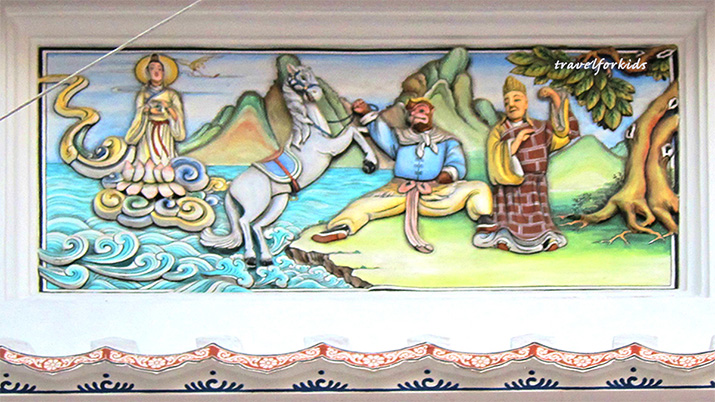
This mural is from a Buddhist temple in Bangkok, with a scene from Journey to the West.
Goddess Guanyin is on the left, white horse is rearing up, Monkey King on the bank is holding his bridle, on the far right is monk Tripitaka. The scene portrays moment after the dragon has transformed into a horse.
In the story, Tripitaka riding on his white horse and Monkey King arrived at a stream. A dragon leaped out of the water, Monkey rescued the monk, but the small dragon gobbled up the horse in one gulp. Angered, Monkey King attacked the dragon, but neither could win, and the dragon escaped back into the water.
This dragon, son of Dragon King of the Western Ocean, got into trouble and was ordered to this stream to wait for monk to arrive and help him on his journey. But the dragon was hungry, so he ate Tripitaka’s horse.
The goddess Guanyin is sent for, and arrives to sort out the problem. Guanyin takes a willow branch, sprinkles dew over the dragon and cries out “Change!” The dragon changes into a white horse, exactly like Tripitaka’s horse.
Guanyin departs in swirling colored mists, the monk gets on White Dragon Horse, and accompanied by Monkey King, they continue on their journey.
Tripitaka and his disciples take fourteen years to journey to mythical western lands, and bring back the Buddhist scriptures. When Tripitaka arrives in Chang’an (Xi’an, he speaks very positively to the Emperor about White Dragon Horse.
“I am greatly indebted to him for taking me over mountains and summits and through the most treacherous passages. Whether it be carrying me on my way there or bearing the scriptures upon our return, we are much beholden to his strength.”
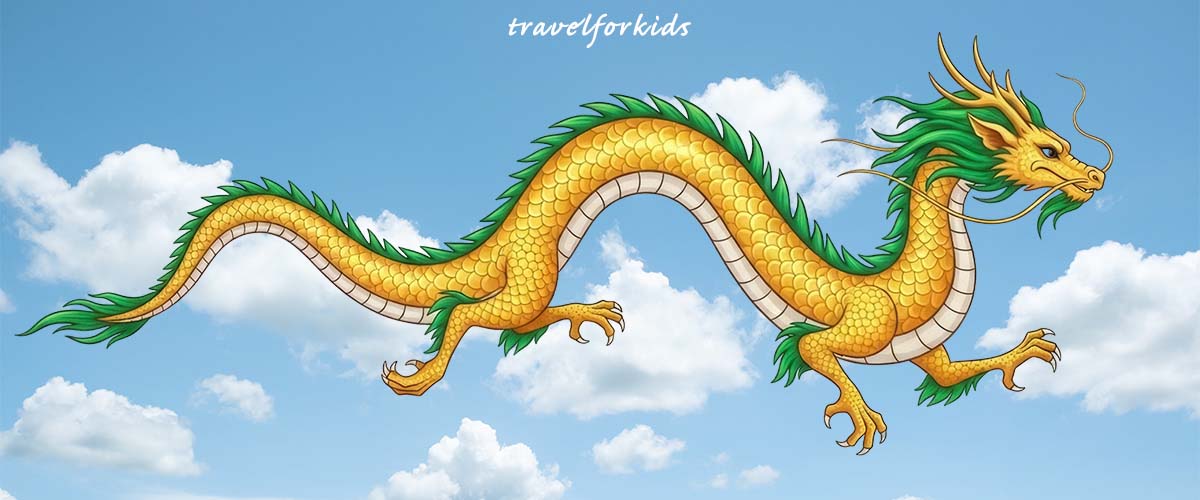
On the monk’s recommendation, White Dragon Horse is now awarded divinity. He is taken to the Dragon Transforming Pool, where his white horse coat disappears, now he has horns on his head, long silver whiskers, and is covered in golden scales. Wrapped in clouds, the dragon soars up into the heavens.
Children’s Books
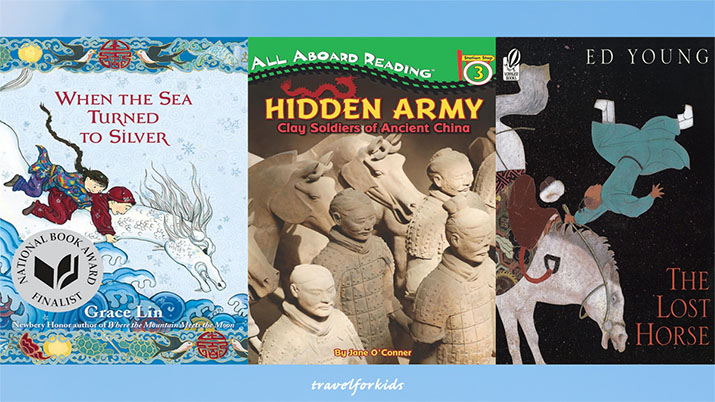
When the Sea Turned to Silver
by Grace Lin
Fabulous fantasy adventure, the Black Tortoise of Winter has turned the sea to silver. Pinmei and her companion Yishan set off on a journey in snow and ice to the City of Bright Moonlight.
Pinmei and Yishan meet up with Lady Meng and her white horse BaiMa, a magical horse who flies them all to the city. BaiMa carries the children to the frozen sea, and down into the underwater palace of the Sea King, where BaiMa is returns to his immortal form, a dragon. Stories within stories, fabulously illustrated! (Illustrated chapter book)

Hidden Army: Clay Soldiers of Ancient China
by Jane O’Connor
Amazing discovery of the terracotta warriors, thousands of life-sizeearthenware figures guarding the tomb of Emperor Qin Shi Huang, buried for more than 2,200 years. Find out about the archaeological site, how the figures were made, soldier’s armor, weapons, and horses. Super close-up photographs of the terra cotta warriors. (Easy reader)
Also picture book: The Emperor’s Silent Army
Journey to the West – Perils on Earth
Journey to the West – Enlightenment
by Cheng’en Wu, Ying Ping Low, Koo Jia Yi, Charlotte Ng
Adventures of monk Tripitaka, White Dragon Horse, Monkey King (Sun Wukong), and two disciples on their quest to bring back the Buddhist scriptures to China.
In Perils on Earth, Monkey King steals a magical ginseng fruit and ruins the tree, Tripitaka is kidnapped by the Yellow Robe Monster, they battle Red Boy, a demon with immense fire-making powers, and save children from being eaten a goldfish turned into a river demon.
The adventures continue in Enlightenment, Monkey King is captured in a magical snare, Tripitaka is tied up in silk threads by seven spider spirits tie up, are attacked by a centipede monster with many, many eyes, but after 14 years they secured the Buddhist scriptures and return to the Emperor. Their quest is done, they have gained enlightenment, White Dragon horse is rewarded by being turned back into a dragon. Good for older kids. (Graphic novel)
Chengli and the Silk Road Caravan
by Hildi Kang
Young Chengli joins a caravan, traveling the Silk Road from Chang’an to Kashgar. Exciting adventures as he saves a princess from bandits, survives deadly sandstorms and snow in the Tien Shan mountains, where learns to ride horses like a Kazakh, and follows the wind of the desert. (Chapter book)
The Lost Horse
by Ed Young
This is the story of from a Chinese folktale about a man, and a horse.
Sai is a very poor man, but he had a strong fast horse. The horse escaped into the night during a thunderstorm. But Sai said, “You know it may not be a bad thing.” When his horse returned with a mare, he said “It may not be a good thing.” A timeless story about life’s fortunes. Beautifully illustrated, especially the horses, reminiscent of beautiful Tang dynasty horse figurines. (Picture book)
Horses Gallery
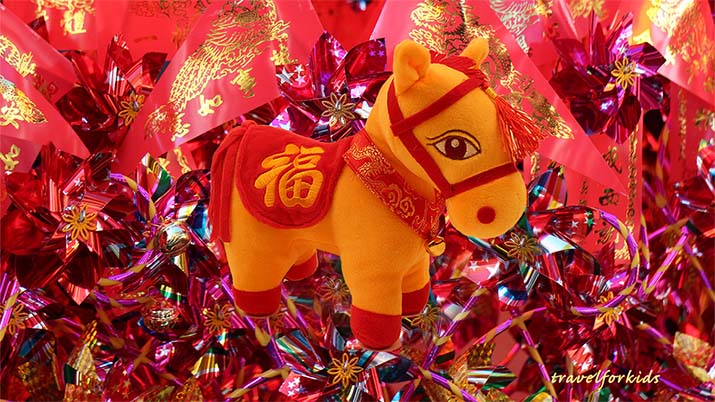
Golden horse, Chinatown San Francisco
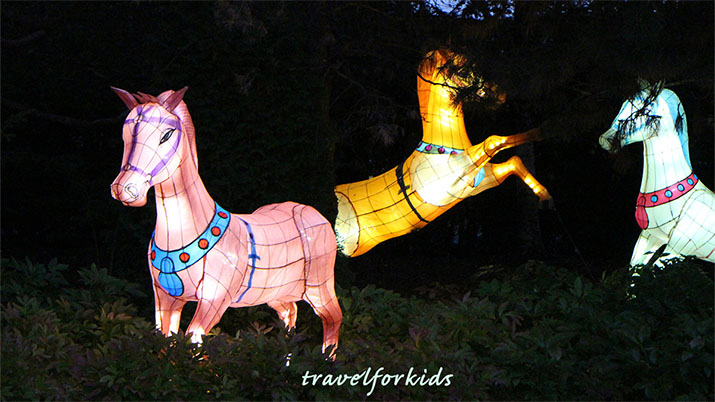
Montreal Lantern Festival
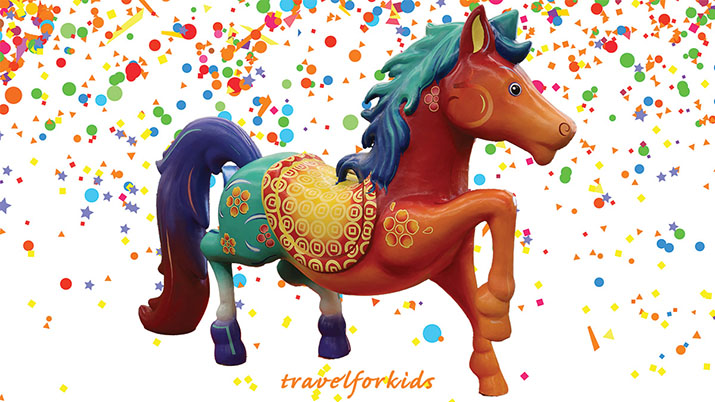
“Lucky Horse” 2026
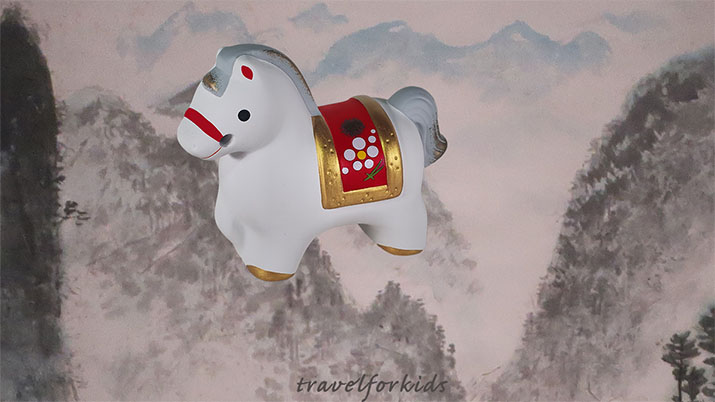
Perhaps White Dragon Horse from Journey to the West?
Travel tip: When you visit art museums, check out Asian galleries with exceptional ancient Chinese art. Horses are so realistically rendered, they look ready to ride or fly out of the gallery.
Metropolitan Museum of Art (New York)
Asian Art Museum (San Francisco)
Philadelphia Museum of Art (Philadelphia)
Museum of Fine Arts (Boston)
National Museum of Asian Art (Washington DC)
British Museum and V&A (London)
Musee Guimet (Paris)
Find out more about Lunar New Year celebrations – videos, children’s books, and recipes for fun food to make for the holiday.
Writer’s note
This long form blog post is original research, writing, and images from our photos, taken over years of visits to historic sites and art museums.
Elizabeth Young
Travel for Kids
created by people, not AI